Answers you can verify
Every answer cites the document, the page or slide and the excerpt used. If a dependency is missing, the application says so instead of making things up.
An open-source RAG platform for analysing documents with locally hosted AI models, source-backed answers and control over your data.
RAGatm Open answers your questions from your own documents. It retrieves the relevant passages, hands them to a language model running on your machine, and returns an answer that cites its sources.
Everything runs on your side: the application, the database, the models. In the qualified configuration, no document is sent to a remote AI provider, and the published code contains no fallback to an external service.
Every answer cites the document, the page or slide and the excerpt used. If a dependency is missing, the application says so instead of making things up.
Local models, internal networks without Internet egress, a single published port. You control hosting, backups and access.
The Compact profile is qualified on an 8-thread, 14 GB RAM machine with no GPU. Three open models, downloaded once.
Real screenshots of the Open edition, on an isolated instance with fictitious documents.
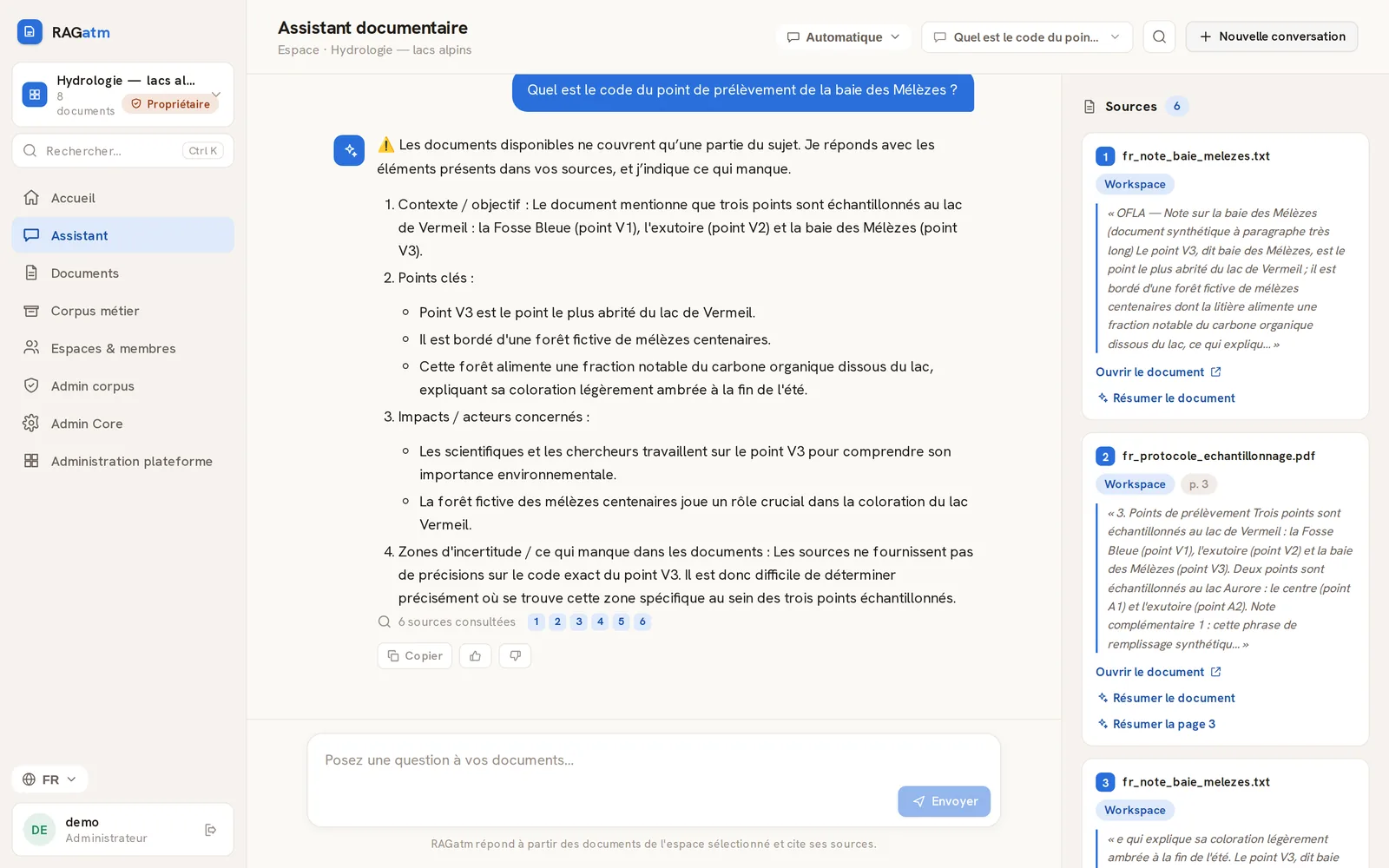
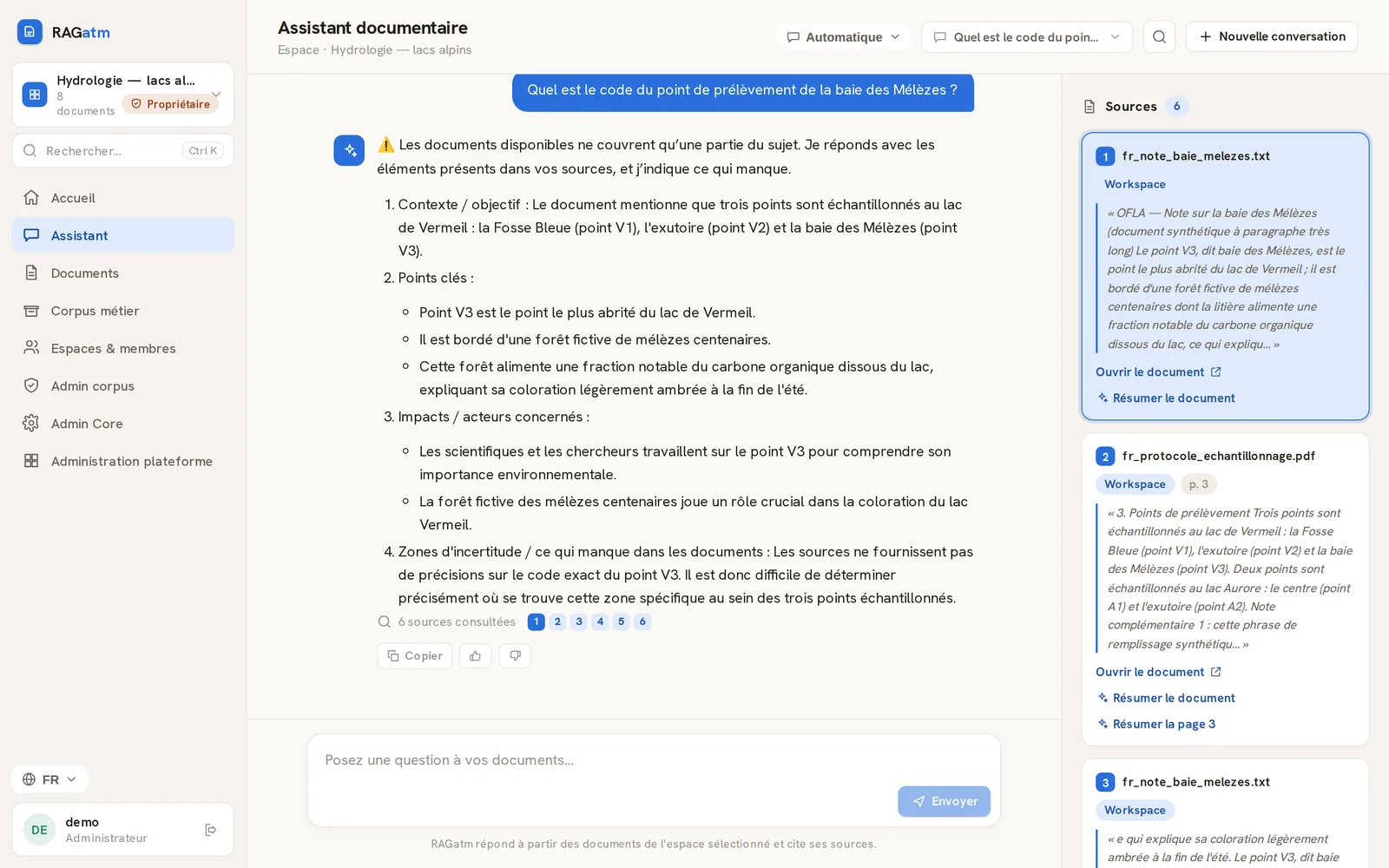
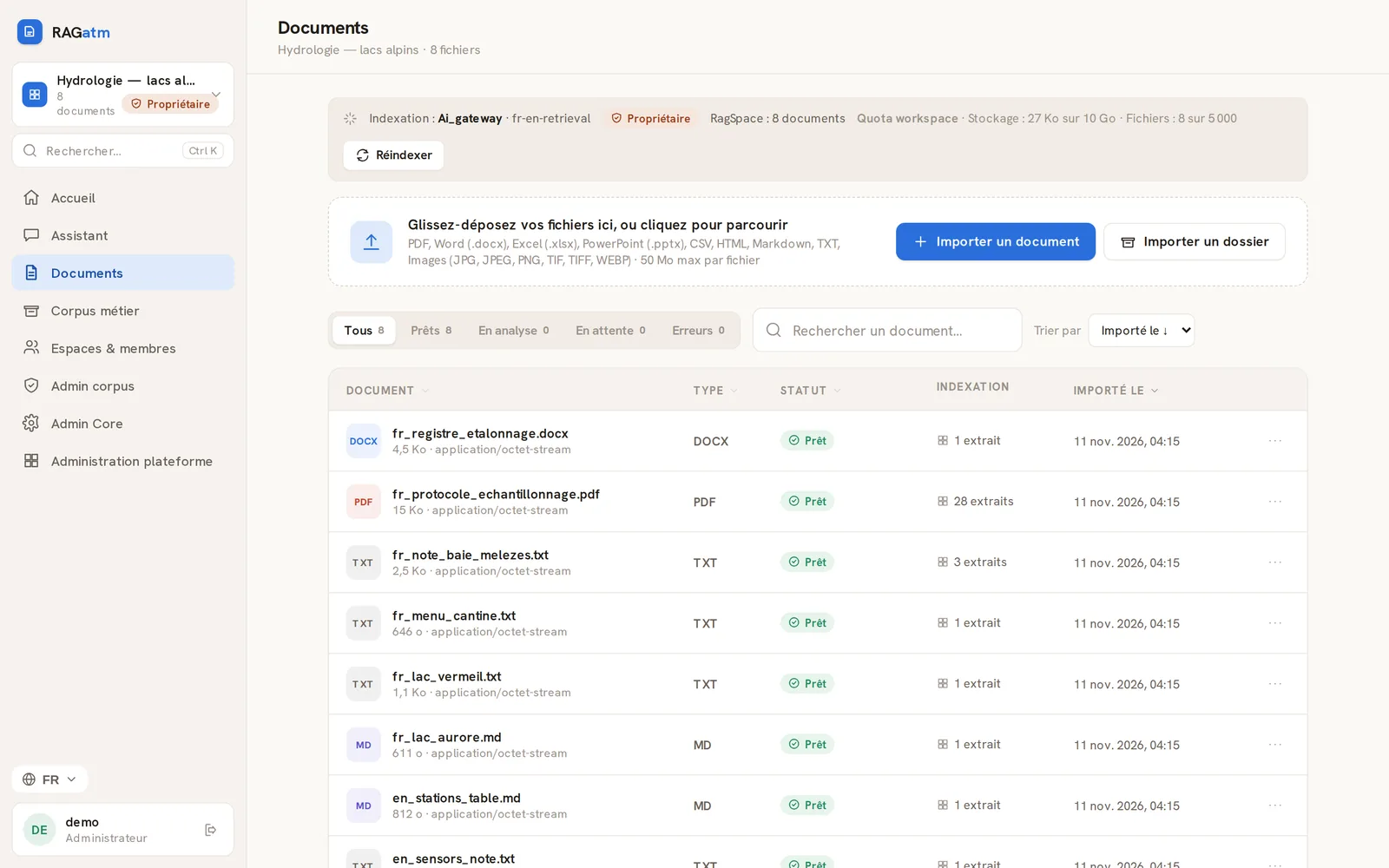
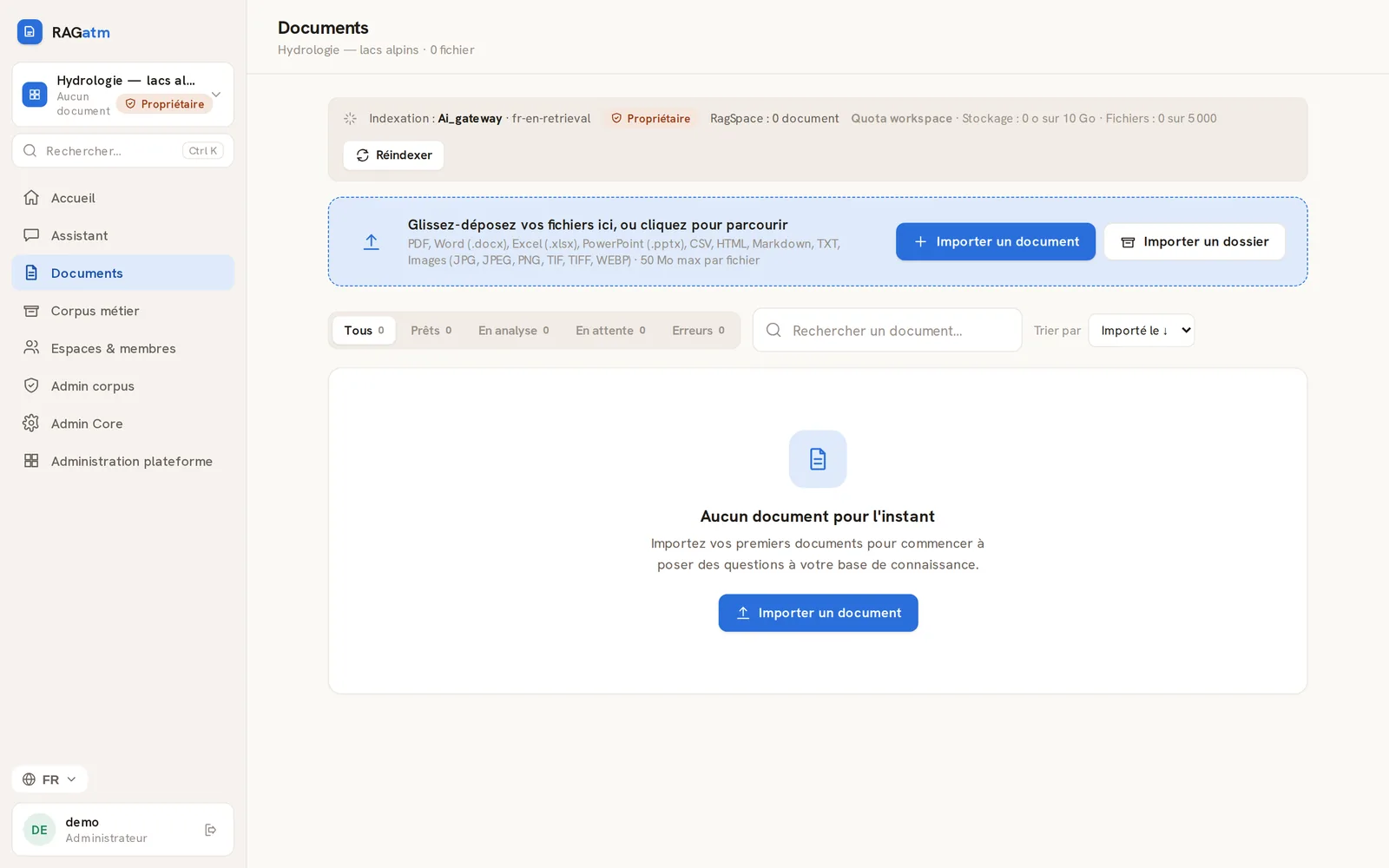
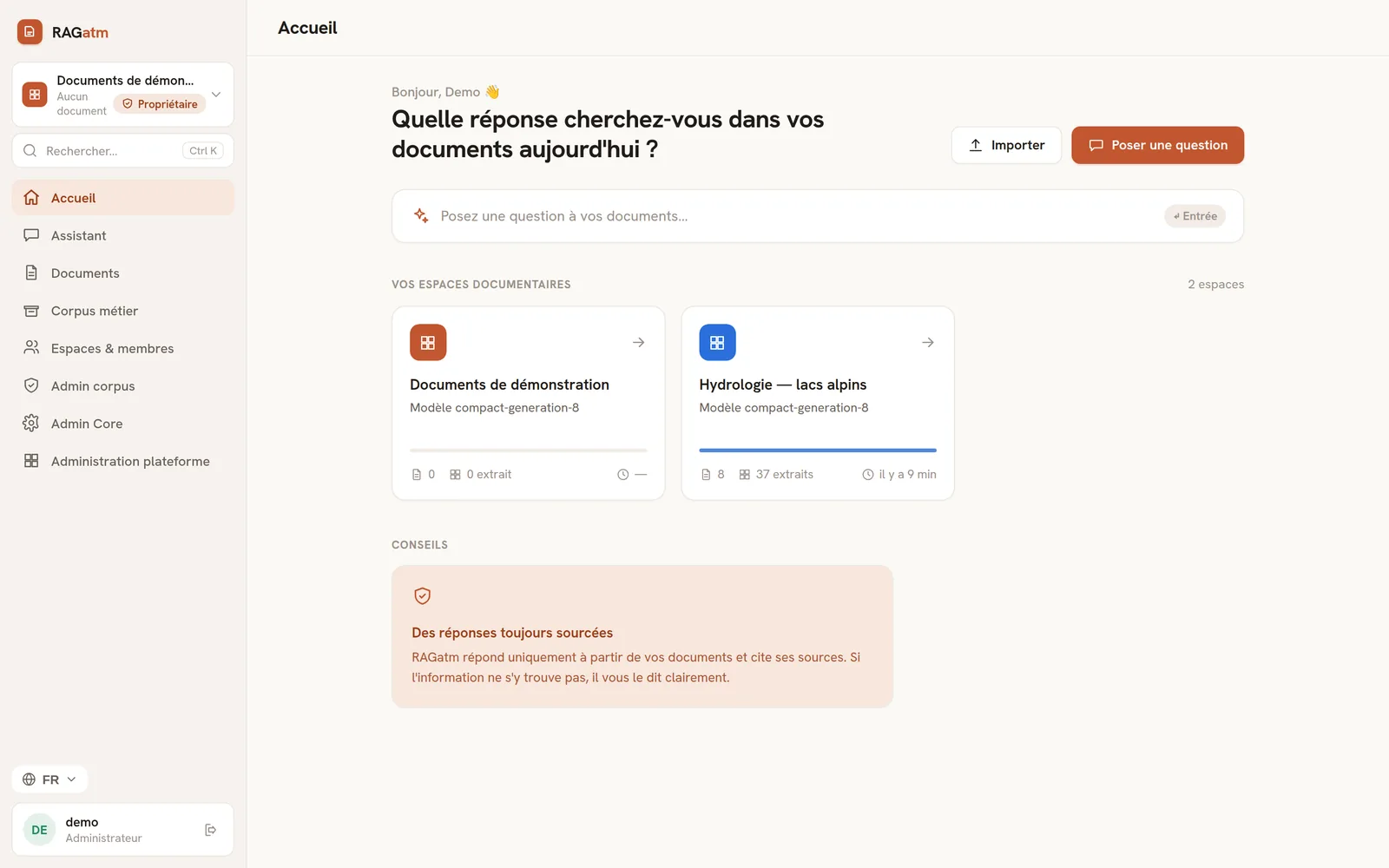
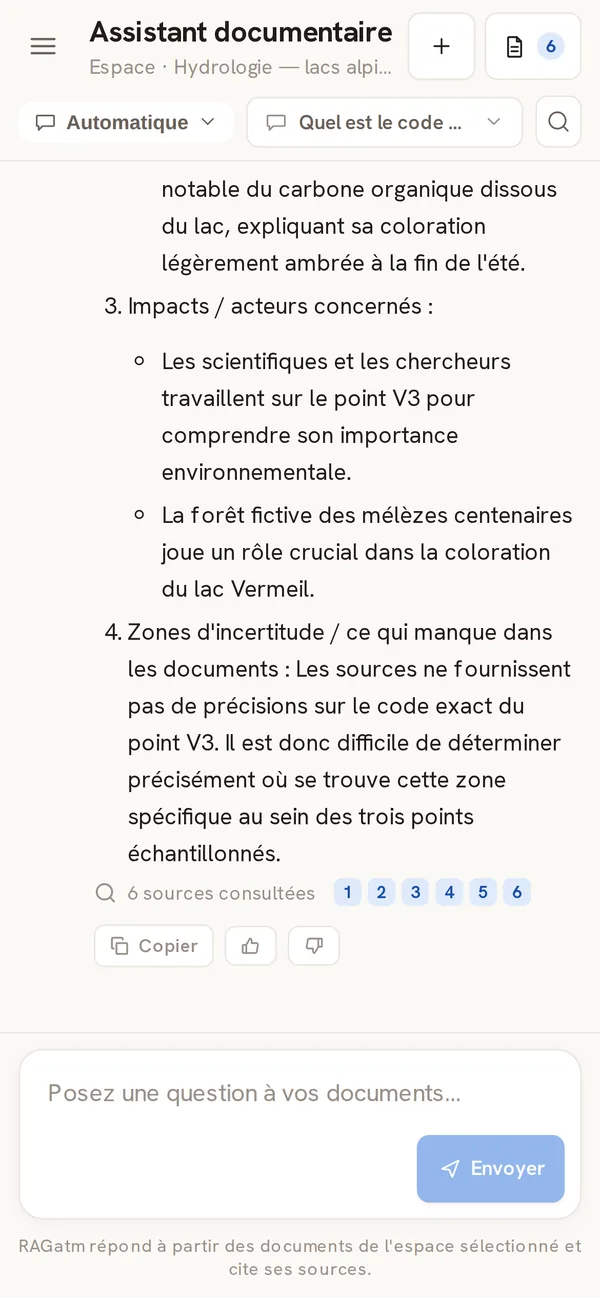
Screenshots taken on an isolated RAGatm Open instance (Open edition, Compact profile on CPU, reranker disabled for the capture), with the fictitious documents published in the repository and a demo account.
The complete flow is described on the Architecture page.
Drop your files into an isolated document space. Content is validated by its signature, extracted, then chunked.
Each chunk gets a locally computed vector and joins PostgreSQL’s full-text index.
Hybrid retrieval (keywords and vectors), then reranking by a local cross-encoder.
A local model streams the answer, with typed sources for each statement.
Organisations that want to query their documents without handing them to a remote service.
Procedures, contracts, reports, technical documentation.
Search and comparison across large case files, on controlled infrastructure.
Archives, bylaws, minutes, internal procedures.
Notes, publications, personal collections.
Docker Compose deployment, API, contracts, modules.
The catalogue lists every format identified in the code, with a verified status for each.
Statuses evaluated for the Compact profile as published. 44 formats listed.
What the published code allows, what is enabled by default, and what remains your responsibility.
Generation, embeddings and reranking go through AI Gateway Open, which only calls local engines (Ollama, TEI).
The only accepted value for the external fallback is "none"; startup checks reject any other configuration.
Internal Docker networks, a single port published on loopback, no Internet egress in nominal operation.
Three Apache-2.0 repositories, hash-locked dependencies, base images pinned by digest.
Documented backup and restore procedures; no model weight or data leaves your host.
Mandatory TOTP second factor for every account, workspace roles, isolated spaces.
Free software with no per-user licence, running on a server without a GPU. Developed in France, with a European approach to technological control; no sovereignty certification is claimed.
Self-hosted software is not "compliant" or "sovereign" by nature: regulatory compliance and host security remain the operator’s responsibility.
Compact profile on CPU, full stack, synthetic corpus of 8 documents and 10 questions.
One application, one model gateway, one optional pool. Each component has a role and a contract.
ragatm-openLocal-first document Q&A (RAG) platform: isolated document spaces, asynchronous ingestion, hybrid retrieval + reranking, cited answers, models run locally through AI Gateway Open.
ai-gateway-openLocal inference gateway: generation (aggregated and NDJSON streaming), embeddings with verified pipeline identity, cross-encoder reranking, strict model registry, typed errors, non-inferential health probes. No remote provider.
ai-gateway-pool-openStandalone HTTP router in front of one or more AI Gateway Open instances, without changing the gateway-api/1.0 contract: node selection, circuit breaker, upstream allowlist, job affinity, saturation handling. Optional for Compact.
Two repositories to clone, a preflight, models to provision, then an offline stack.
Linux x86_64 · Docker Compose · 8 threads · 14 GB RAM · no GPU
git clone https://github.com/ragatm-open/ragatm-open.git
git clone https://github.com/ragatm-open/ai-gateway-open.git   # requis ; placé à côté de ragatm-open/
cd ragatm-open/compact && scripts/preflight.shNot in the qualified configuration: all models run locally and the published code contains no fallback to a remote provider.
No. The Compact profile is qualified on CPU. GPU profiles are described but not qualified.
No: images are built locally from source, with base images pinned by digest.
Not in the published Open edition: OCR is a disabled build option, and the gateway contains no speech-to-text engine.